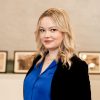

Tucked away inside an old school building on Isabella Street in Newport, researchers and students are working on learning more about cancer.
Julia Carter and her husband, Harry Carter, started the independent nonprofit Wood Hudson Cancer Research Laboratory over 40 years ago. The center works to study clinical cases and experimental models to diagnose and treat cancer, learn environmental chemicals that could be cancer-causing, and work with students to encourage them to stay in biology and pursue careers in science.
The lab in Newport is home to over 2 million tissue samples collected by St. Elizabeth from roughly 68,000 patients across Northern Kentucky, which helps them work toward finding new prognostic markers and cancer treatments.

Before the lab became what it is today, Julia Carter was a student from Connecticut working in the Cancer Research Institute of New England Deaconess Hospital lab in Boston, learning about breast cancer.
Carter decided against her original plans to study the philosophy of science in England and chose to stay in Boston. There, she met her husband, Harry, who was working with people from the Harvard School of Public Health on breast cancer.
After the Carters got married, they moved to New Jersey, and she attended Rutgers University in the physiology department, where she received her master’s degree and then her Ph.D. She continued working at Rutgers for two years as a postdoctoral fellow to the Bureau of Biological Research director.
The couple found their way to Cleveland, and Carter said she couldn’t find a job, so she created her own.
“We arrived in Cleveland, and there just weren’t any jobs doing cancer research,” she said. “So, being rather discouraged, I looked around at what we had. We had a place to work and some equipment— a microscope, an electric typewriter, and filing cabinets. So, I looked into becoming incorporated.”
She started asking around for advice. Carter said she asked her business advisor what he thought, and he told her she would never get a grant. She asked a lawyer for his thoughts, and he told her she would never get named a nonprofit — further, she was told by her postdoctoral advisor that she would never get a publication.
“Fortunately, all three of them were wrong,” Carter said. “We had nonprofit status within eight weeks, we had our first grant within the first year, and we started publishing. Fortunately, I wasn’t dissuaded.”
Harry Carter’s job brought them to the Greater Cincinnati area, and they found a former corner drug store on Greenup Street in Covington in 1985 to set up shop for Wood Hudson. At the time, they had a conditional permit that only allowed six people to be in the building simultaneously. They also started having students take an interest in working with them.
“We had students from Thomas More and Northern [NKU], and we couldn’t do anything because we were trying to set up a tissue culture lab and all that, but it just wasn’t enough space,” she said.
They were approached by the head of economic development in Newport, who appointed them to the closed Catholic school building they bought in 1990.
Since its implementation, Wood Hudson has had over 350 students, and 92% have gone into careers in science or medicine. After three years of Zoom classes, the center recently got its students back in the lab. There are five students currently working at Wood Hudson, and they will receive more in the summer.
The researchers and students who work in the labs study tissue cultures anonymously. All personal information is blacked out when they receive the samples from St. Elizabeth. Julia Carter said that when they are interested in new tissue, they must read the pathology and understand what happens with a patient with a tumor. She said they develop a hypothesis and begin an experiment.
Wood Hudson is an independent, not-for-profit lab, which means they do basic research without commercial value. Julia Carter said they were forced to close during the pandemic and ultimately lost around $500,000. Earlier this month, the lab was awarded a $100,000 grant from the state for its loss of income in 2020 and 2021.
Carter said funding is a continuous battle because they have to fund the research, but research generally doesn’t generate money.
“You’ve got many series of problems. This is what is so great about these provocative questions of cancer because there are many unknown and unanswered questions from cancer,” she said. “And either you know a procedure that you can do to provide a service for which you get paid, or you try to use your brain to figure out an answer to an unknown question.”