

After a forensic audit put Fort Thomas’ accounting discrepancy at more than $847,000, up from the $322,000 previously identified, city officials say they have added new financial safeguards to prevent years of accounting errors from piling up again.
The changes follow more than a year of scrutiny over the city’s financial records and questions about how such a large discrepancy went undetected. Forensic accounting firm Dean Dorton found years of accounting and oversight failures, but no unauthorized payments to the city officials and related entities it examined.
The review identified transactions that were recorded incorrectly, entered months late, or never entered into the city’s accounting system. Bank accounts weren’t being reconciled monthly, payroll wasn’t always fully recorded and multiple bank and investment accounts were lumped together in the city’s general ledger.
“This isn’t an occasional slip-up,” Fort Thomas Councilmember and Finance Committee Member Eric Strange said. “This is systemic failure of the accounting function over multiple years, potentially going back as far as 2013.”
The finance director, city administrator, mayor and outside auditor responsible for financial management or oversight while the accounting problems developed are no longer in those respective roles, Strange and Fort Thomas Mayor Andy Ellison said.
Fort Thomas now reconciles its bank accounts monthly and provides monthly financial reports to the city council, among other changes. The city also plans to have an outside accounting firm independently review its books quarterly.
The findings build on problems first uncovered during Fort Thomas’ fiscal year 2023-24 financial audit, when accounting firm Chamberlin Owen identified significant deficiencies and a $322,498 discrepancy the city ultimately wrote off as a prior-period error.
City council later hired Dean Dorton for up to $35,000 to conduct a forensic review, both to investigate the discrepancy and recommend controls to prevent the problems from happening again.
That investigation ultimately calculated an $847,335 difference between what the General Fund’s accounting records showed and actual cash as of June 30, 2024.
Understanding how $322,498 became $847,335, however, requires an important distinction: Dean Dorton did not discover another roughly $525,000 had disappeared from a city bank account. The firm reconstructed transactions and found errors on both sides of the city’s books — money received by the city that wasn’t properly recorded, as well as legitimate payments the city made that were missing or incorrectly recorded.
For example, Dean Dorton found opioid settlement money and federal American Rescue Plan Act funds that had been received but were not properly reflected in General Fund cash. Auditors also identified $585,256 in outgoing payments that had either been missed or incorrectly recorded, including employee health insurance transfers, deferred compensation contributions, flexible spending account contributions and payroll processing fees.

Correcting all of those entries ultimately left the $847,335 difference.
“Most people don’t understand-they think that these dollar amounts disappeared out of our bank account, and that’s not the case,” Ellison said. “They weren’t recorded correctly in our books.”
Dean Dorton’s forensic testing covered July 1, 2020, through June 30, 2024. The accounting problems themselves, however, stretch further back. The report found evidence of internal-control deficiencies dating to 2013 and determined the General Fund cash account had not been properly reconciled since at least fiscal year 2016-17.
The city chose the four-year forensic period in part because older records became increasingly difficult to locate and reconstruct, Strange said. Going further back would have also required more time and taxpayer money while potentially providing less reliable results because records became less complete.
The four-year review was also intended to determine whether there were signs of improper payments that warranted digging further.
Dean Dorton examined transactions involving the current and former city administrators and former finance director, as well as entities related to them. The firm reported finding no unauthorized payments to those individuals or related entities during the period it examined.
Had the review uncovered indications of fraudulent activity, Strange said officials expected the investigation would have needed to expand. Instead, he said, multiple reviews have pointed toward failures in accounting and oversight rather than unauthorized payments.
With the forensic investigation identifying many of the same problems found in the city’s previous financial audit, Fort Thomas officials are now focused on the other reason they commissioned the review: preventing the accounting failures from happening again.
Many of Dean Dorton’s recommendations were already being implemented before the forensic report was completed, Ellison and Strange said.
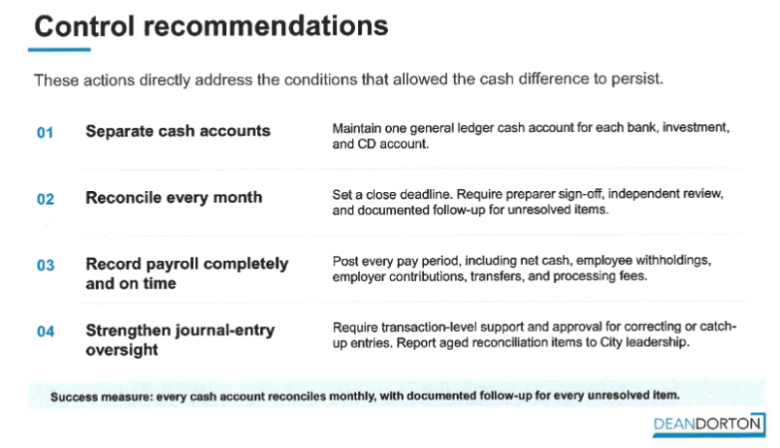
For starters, Fort Thomas now reconciles its bank accounts every month.
A reconciliation compares what the city’s accounting system says is in an account with what the bank says is actually there. Done regularly, a discrepancy can be identified and investigated rather than accumulating unnoticed.
Previously, multiple checking, investment and other accounts were lumped together under one General Fund cash account in the city’s accounting system. The accounts are now separated, allowing the city to reconcile each one individually.
Payroll procedures have also changed. Dean Dorton found some payroll entries were recorded months after employees had actually been paid and weren’t always broken down to properly account for taxes and other obligations. City finance staff are now recording those transactions as they occur.
Fort Thomas has also added additional people to the oversight process.
Fort Thomas Interim Finance Director Linda Chapman is overseeing the city’s finances while it searches for a permanent finance director. Ellison also hired an outside Certified Public Accountant firm after a finance director hired by the city left after only several months.
Ellison said the firm will not permanently handle the city’s day-to-day accounting, but the city plans to keep it involved after a new finance director is hired to independently review the books quarterly.
“I wanted somebody that wasn’t a part of the building to be looking at all the books on a daily basis,” Ellison said.
Ellison and Fort Thomas City Administrator Matt Kremer are also reviewing payments twice a month. Ellison said he personally examines every invoice and check.
The city council is receiving more information as well. Members now receive monthly financial reports, which Ellison said wasn’t previously done, and the city began holding quarterly finance committee meetings last year.
The city’s annual independent financial audit provides another layer of review.
Those changes are intended to address a central problem identified by the audits: Having accounting procedures isn’t enough if no one is checking that they’re actually being followed.
The city is also working to improve its record retention and digitize more financial documents. Ellison said investigators had difficulty locating some older records, particularly after city hall was emptied for a renovation and later moved back in.
Finding a permanent finance director remains one of the biggest pieces still unresolved.
Strange said experience in governmental accounting will be particularly important because the job requires knowledge that doesn’t necessarily come with general accounting experience.
“Even if you understand accounting and have an accounting background, government accounting is a different animal,” Strange said. “It’s almost like you speak a language, but it’s a different dialect.”
Strange said the city also wants someone with integrity and enough experience to handle the position without elected officials having to constantly look over that person’s shoulder. The new controls, he said, should provide safeguards and catch mistakes, but they don’t eliminate the need for someone capable of properly managing the city’s finances.
Strange said the discovery of additional historical errors through the forensic review can make it appear as though the city’s financial problems have continued to worsen, particularly as the discrepancy increased from $322,498 to $847,335.
“It appears that things are getting worse because you go from the 322 to the 847,” Strange said. “But it’s important to note these things all took place in the past.”
He also pushed back on the idea that the accounting discrepancies mean Fort Thomas is currently in financial distress.
Strange pointed to the city’s fiscal year 2027 budget projections, which anticipate operating revenue exceeding operating expenses by more than $1.5 million. He also said the city currently holds reserves equivalent to roughly six months of operating expenses.
“The financial position is good,” Strange said.
Ellison said the current administration has strengthened financial oversight, separated responsibilities and corrected previous accounting entries.
“We didn’t create these deficiencies,” Ellison said. “We uncovered them, we brought them to light, and we began fixing them before audits even told us about them.”
Dean Dorton is scheduled to formally present the forensic audit to Fort Thomas City Council on Oct. 8, when residents will have an opportunity to hear directly from the firm about what it found.
Dean Dorton’s General Fund Forensic Review can be viewed below: