


Fort Wright has begun the process of regulating delivery drones and drone stations within its borders, making it the first city in Kenton County to do so.
The move follows hints from Walmart earlier this year that the company would begin operating delivery drones out of its Fort Wright location. If enacted, the new city regulations would actually prevent Walmart from having drone stations at its Fort Wright store. Even so, the regulations are meant to encompass the technology more generally, based on statements from local leaders and professionals.
“This really isn’t about Walmart,” Fort Wright City Administrator Jill Bailey told the Kenton County Planning Commission Thursday night. “It’s about addressing a technology that we are unfamiliar [with] in this region.”
The planning commission voted on Thursday to recommend the new regulations and send them back to the Fort Wright City Council for final approval.
Bailey confirmed the regulatory push started with Walmart’s drones–even though the phenomenon would likely become more generalized–and pushed for broader considerations in the light of delivery drones’ proliferation.
A representative from Walmart contacted Mayor Dave Hatter earlier this year about the prospect of “exciting technology,” according to an email from Walmart the mayor shared with LINK nky. Hatter then brought his concerns to the Kenton County Mayors Group in March.
“As I understand, it is still illegal to shoot them down in Kentucky,” Hatter joked at the time. “I may be testing that theory soon.”
An announcement from Wing, the company that makes the drones, in January said it and the chain retailer were planning on expanding drone delivery service to 150 new stores throughout the country over the course of the fiscal year. Cincinnati is listed as one of the major metro areas where this expansion will take place. Walmart first began using drones to make deliveries in 2021, according to a 2025 announcement from the company.
Independence Mayor Chris Reinersman, who also serves on the management board for Kenton County Planning and Development Services, recommended in March that Hatter consider zoning rules as a way of regulating the technology locally.
Yet, the push on the part of Walmart to bring delivery drones to the Fort Wright super center, which is located on Valley Plaza Parkway, seems to have decayed since March. A Walmart spokesperson told LINK nky this week the company had no news about delivery drone expansion in the region.
“We continue to explore opportunities to expand drone delivery with Wing and remain encouraged by the positive response we’ve seen from customers using the service in communities where it is available today,” the spokesperson said.
Bailey said that Walmart had since turned its drone expansion to other markets, namely Michigan and Ohio, and expressed frustration about trying to work with the company.
“We invited them multiple times to a public meeting so that the council could engage them and ask questions about this process, so we could understand it a little bit more,” Bailey said. “And, unfortunately, they have declined to do that.”
The Fort Wright City Council passed a temporary moratorium on drones in the city and its airspace in April. That moratorium will expire in mid-October. Bailey said the city had also reached out to leaders at the airport for advice on dealing with drones.
If enacted, the new regulations would establish new rules around drones and drone stations in the city. Drone stations would be allowed only as accessory uses to buildings in the city’s general industrial zones and could be used only in conjunction with allowable facilities within those zones. That means no free-standing drone stations.
Drones could also not be stored in shipping containers. Moreover, establishing stations would require a public hearing and approval as a conditional use from the Fort Wright Board of Adjustments.
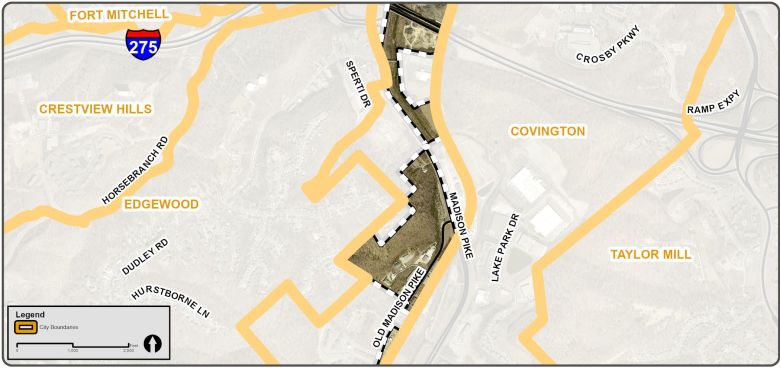
There are several general industrial zones in the city, mostly along Madison Pike. The Walmart on Valley Plaza Parkway is not in a general industrial zone; it’s zoned as a planned unit development, or PUD, as it’s called in county literature.

Other restrictions under the new regulations include requirements for asphalt or concrete paving, fencing or walls and landscape buffers. Drone stations on roofs would have to be shielded from public view.
You can read a full text of the proposed regulations, set off in yellow, here.
Although cities could establish regulations like these, there is still a lot about the regulation of drones (or any aircraft, for that matter) that local governments wouldn’t have any say over. The planning commission’s attorney, Matt Smith, explained these jurisdictional boundaries.
“Once it leaves the ground, we no longer regulate it,” said Smith. “Anything on the ground–we can regulate buffering, staging areas in which it can take off, areas in which it can land. As it takes off–hours of operation, what it looks like, striping, lighting; we can’t control any of that.”
Many of the regulations for aircraft in, well, the air fall to the Federal Aviation Administration. In fact, those regulations may soon expand specifically for drone flights.
The Federal Aviation Administration released a proposed rule change in May that, if enacted, would prohibit drone flights over 16 categories of critical infrastructure, including communications structures, dams, power plants and other energy infrastructure and water infrastructure. The public comment period for the proposed rule change ended Wednesday.

Just one example of how that would affect Fort Wright directly is the 10.5 million-gallon equalization tank near I-275, designed to collect excessive water runoff during extreme weather events. Under the new federal rules, drones conceivably would not be able to fly over it. In short, even if Walmart drones are no longer an issue, drones generally still are, and Bailey encouraged a regional outlook on considering how to properly regulate them.
“You got to start somewhere,” said Paul Darple, the planning commission’s vice chair.
The vote to recommend the regulations was unanimous.
