This story originally appeared in the Aug. 23, 2024 edition of the LINK Reader.
Matt Baker has seen big changes in Northern Kentucky public education in his six years as superintendent of Walton-Verona Independent Schools.
As with all change, some is positive and some is not. A dichotomy has developed in the region, with school districts ramping up learning and out-of-school options while simultaneously struggling with the needs of an increasingly economically disadvantaged student population.
For an example of what’s going right, Baker mentioned Ignite Institute – a career-centered and highly selective 183,000 square-foot high school that opened in 2019 as NKY’s first regional public school. More good change cited by Baker is NKU’s Young Scholars Academy, a college immersion program for dual-credit high school students that began in 2020 with Kenton County Schools. It has since expanded to accept public high school students from the river cities and beyond.
Positive change in performance of the region’s 13 public school districts that serve almost nine in 10 – 87% – of the region’s 68,493 schoolchildren has also been reported, based on comparing state education accountability ratings for the 2018-19 and 2022-23 school years. Every NKY public school district made at least some improvement in state ratings over the five year period, with the most improvement reported at the high school level in Ludlow and at the middle school level in Southgate.
NKY has also outpaced state elementary and middle school benchmarks as Kentucky’s fourth- and eighth-grade national reading and math scores were on par with scores in most states based on 2022 scores, the most recent available, of the National Assessment of Educational Progress, or NAEP, scores.
In Walton-Verona, overall performance ticked up at the middle school level between 2019 and 2023, state data shows. Baker told LINK the district’s “robust process to identify and track the progress of students who struggle academically” is leading to success.
Disparities also are reported in the region. One is state funding of public schools, an issue recently reported on by LINK. There is also a rise in the percentage of NKY students classified as economically disadvantaged – a term defined by the Kentucky Department of Education as “income eligible for free or reduced-priced [school] meals.” It’s an issue that goes beyond nutrition.
Economically disadvantaged in schools
In its education assessment released in May, EducateNKY, a local nonprofit formed to study and improve the NKY education landscape, made it clear that NKY has consistently outpaced the state in the percentage of students who enter kindergarten ready to learn and other measures.
Educational progress in the region is not exactly equal, however. School districts with a larger percentage of economically disadvantaged (or lower socioeconomic status) students have often fallen behind more affluent districts in overall performance, based on state accountability data from the Kentucky School Report Card, a broad-based school transparency site maintained by the state Department of Education.
NKY’s highest rates of economically disadvantaged youth, based on 2022-23 data, were in the river city districts, with Covington Independent (at a rate of 89.5%) and Newport Independent (at 90.3%) at the top of the list. Both districts also had the lowest overall state accountability rating for their high schools in 2022-23, per the data, and Newport rated at the bottom for overall middle school performance.
Though the rate is highest in Covington and Newport, the percentage of economically disadvantaged students is on the rise across Northern Kentucky. Boone and Kenton county schools – the largest districts in the region – had a two- to three-percentage point increase in their number of economically disadvantaged students between 2018-19 and 2022-23, according to state accountability data. (Campbell County’s percentage has stayed nearly the same at around 47.5%.) Even more affluent districts have seen an increase; state data shows the percentage of economically disadvantaged students increased from 8.6% to 11% in Fort Thomas Independent between 2019 to 2023.
In Walton-Verona, the rate was 39.8% economically disadvantaged for the 2022-23 school year. While that was the third lowest percentage in the region behind Beechwood and Fort Thomas, it’s historically a big change: 20 years ago that percentage was closer to 5%, Baker told LINK.
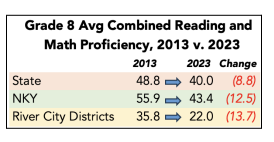
As rates rise, NKY has slipped in key education benchmarks like school readiness and eighth grade math and reading, based on EducateNKY’s assessment. Although still outpacing the state overall, NKY dropped 2.6% in the percentage of school-ready students between 2014 and 2023 based on state data gleaned from the assessment and shared below. A 12.5% drop in the average combined NKY eighth grade reading and math proficiency was reported over the same period.
Erosion in the river city districts is more pronounced:

Tim Hanner retired from EducateNKY in July and served as its president and CEO. He told LINK in May that academic performance in districts with high levels of economically disadvantaged students goes beyond test scores. Test scores reflect systemic barriers to learning, like high absenteeism, housing instability, truancy, workforce barriers, transience (routinely switching schools) and more, he said.
“Down here, when one in three kids in Newport who start the year won’t be there at the end of the year, that’s an issue,” Hanner told LINK. “How do you build continuity? How do we help stabilize communities?”
That’s EducateNKY’s ultimate goal, according to the assessment.
Making education a priority
This fall, EducateNKY is expected to release a strategic plan that addresses the region’s shortcomings. That plan will center on a list of five “strategic priorities.” LINK takes a brief look at each priority below.
• Early learning. A key focus within this strategic priority is kindergarten readiness. Many river city districts, however, are falling behind in that area, as shown in the chart below:
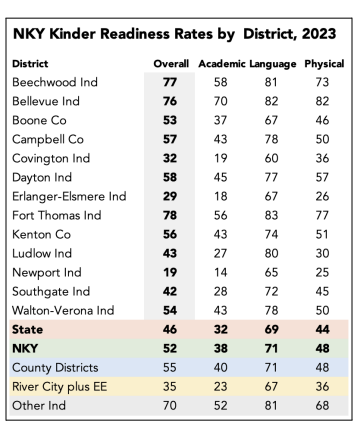
A statewide strategic plan already is in place to help students move from pre-kindergarten to kindergarten and more comprehensively from prenatal to third grade. Regional collaboratives overseen by the governor’s office are working at the same time to prepare children for grade school, as are public and private organizations statewide. EducateNKY intends to set new goals to “hold partners accountable to meet goals for kindergarten readiness” in NKY, according to its assessment.
• Family engagement and partnership. Nearly all the river cities districts have parent engagement initiatives that range from dedicated parent-teacher meeting days to new parent outreach and teacher home visits. But participation is lacking, per the assessment. Recommendations put forward in EducateNKY’s strategic plan later this year will try to change that.
• Mastery learning. The goal, in short, is to make sure students grasp and retain what they are taught. Innovations in personalized learning – reflected in “portraits” of a learner or graduate used in several local districts including Covington Independent – are part of the equation. Statewide, there is also a focus on personalized learning to help students master subjects and content. A new accountability system is being developed by the United We Learn Council to capture that.
• Out-of-school time. Learning goes beyond the classroom, but low socioeconomic status in many districts and a lack of community out-of-school programs has limited access to out-of-school learning in NKY, according to the EducateNKY assessment. Another struggle, reported EducateNKY, is a lack of student exposure to positive new experiences that can be as simple as trying a new food or a hike in the woods.
• Secondary options. NKY has more than a few. Open enrollment in public schools – the flexibility to enroll students outside their assigned districts – is allowed under a 2021 state law. Private schools are plentiful in the region, and there is also the option for home schooling. EducateNKY would like to see more options – new schools or programs, specifically in the river cities – that would serve students regionally, be open instead of selective and “aim to serve a diverse student population who exercise agency in the decision to attend,” said its assessment.
The ‘spirit of the region’
Replacing Hanner at EducateNKY later this summer is Cheye Calvo, the consultant who developed the landscape assessment. The former Marylander who told LINK that he grew up in an economically disadvantaged family sees a lot of potential for progress in NKY and specifically in the river cities.
“There’s a lot of potential for (districts) to work together, align systems, to collaborate and really kind of grow the river cities as a learning community that cuts across geographic boundaries,” Calvo told LINK in June. “And serve kids who may be moving within the school year and year to year, because there’s a good chance that one kid that is in a district this year may be in another district next year.”
Everyone, not just NKY education leaders, has a role to play to meet goals focused on the five strategic priorities, said the assessment. The report said there’s “something in the spirit of the region that does not settle for the status quo” and that “NKY in recent years has shown remarkable capacity to come together around collective impact.”
Northern Kentuckians seem to sense their ability to rise above state benchmarks in school readiness and other areas is precarious. “They are ready for bold, even disruptive, action that will unlock regional potential and create opportunities held back by unfair circumstances,” said the assessment.
In Walton-Verona, Matt Baker expressed that same kind of optimism about NKY’s education future. “We have some of the largest and smallest districts in the state, as well as some of the wealthiest and poorest. This diversity can lead to opposing viewpoints and needs, potentially causing poor relationships between districts.
“However, in NKY, the opposite is true. The public districts work extremely well together and support each other at every opportunity. Every district in NKY is focused on working together to maximize opportunities for our students.”