

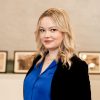

Flávia Maria Cunha Bastos’ first exposure to the U.S. was in the state of Indiana on a cold, gray December day.
Cunha Bastos came to the U.S. from Brazil in the early 1990s to pursue a master’s degree and then a Ph.D. at Indiana University.
“The idea was to go back to Brazil and be rich and famous, I guess,” Cunha Bastos said.
Walking across the Purple People Bridge between Sept. 19 and Nov. 3, visitors will be greeted by 36 panels featuring the faces of immigrants and refugees telling their stories of resilience, peace and hope.
The “More Than Meets the Eye” project features personal photos and related audio stories from immigrants and refugees who now call the Greater Cincinnati region home. The panels have mini magazine-type stories with photographs that people chose for their panels. The project has QR codes that people passing by can scan and listen to the immigrant or refugee’s story straight from their mouth.
Executive & Creative Director, A Picture’s Worth Elissa Yancey helped spearhead the project.
“We thought it would be really important to show not just folks who are new and sort of fit a stereotype of the horrible things we’re hearing about immigrants and refugees that are based on fear instead of facts,” Yancey said. “So, about 1/3 of the folks on the bridge are people who are really well-established leaders in the region.”
This includes people working at places like the University of Cincinnati, Procter and Gamble and the interim artistic director of the Cincinnati Ballet.

Cunha Bastos is now a research professor and visual arts educator at the University of Cincinnati. Her four names are standard practice in Brazil. Maria comes from her grandmother; Cunha is her mother’s last name and Bastos is her father’s.
Upon completing her Ph.D. and returning home, Cunha Bastos said she couldn’t find a job in higher education that was in line with her training and aspirations. She returned to the U.S. for a year as an adjunct faculty member at Ball State University. There, Cunha Bastos said she realized she was valued in an unexpected way.
“I was maybe a gateway to a broader world to a lot of the students who were first generation college students who had never left Indiana,” Cunha Bastos said.
She started to understand how she could contribute as an international academic to a university system, which led her to Cincinnati.
“I grew up in a river town in Brazil that was settled by Germans that had hills like Cincinnati,” Cunha Bastos said. “I think Cincinnati was the closest thing to my hometown I was able to find in the United States.”
She recalls when her family visited the first time and asked, “How did you find this place?”
At UC, Cunha Bastos primarily teaches in the college of Design, Architecture, Art and Planning, also known as DAAP. She said DAAP is an incredibly International college with faculty from all over the world, which helped her find a sense of belonging and home.
Cunha Bastos grew up in a middle-class family in southern Brazil. In high school, she studied French because she thought it was the fanciest language she could learn. When she arrived in Indiana, she spoke little English. The state was also not what she anticipated.
She left Brazil as summer started, but winter was in full swing in Indiana.
“I had dressed appropriately, I thought,” Cunha Bastos said. “When I got out of the plane, I was cold like I’ve never been before. My idea of the United States was either the east or the west coast, so San Francisco, New York or LA.”
Cunha Bastos also imagined public transportation, but instead, she had to comb through her cash and pull together $45 for a limo ride from the airport to campus. From the back of the limo, she saw cornfields and gray skies.
“I thought to myself, what have I done? It was brutal,” she said.
Cunha Bastos said she made some interesting decisions for the first six months because communication was difficult. She would constantly listen to the TV or radio in English and eventually began to pick up the language.
Cunha Bastos’ story is just one people can read about and listen to for the More Than Meets the Eye project.
Others came to the U.S. in search of safety.
Nataliia Kovalova left Poltava, Ukraine, in May 2023 after war struck her town.
Russia invaded Ukraine on February 24, 2022.
In her panel on the bridge, Kovalova describes that morning, “I will never forget February 24, 2022. My daughter and I woke up, had breakfast and were going to go to school. Suddenly, I heard my neighbor screaming. I ran out of the apartment and saw her in the corridor. She cried and shouted only one word: ‘war.’”

Kovalova lived in the war with her daughter for about a year and said it was “simply terrible.” When she was given the opportunity to leave her country, she took it.
Her U.S. sponsor lived in Kentucky, so it was decided that she would come to the Bluegrass State.
“Kentucky is my second home now,” Kovalova told LINK nky. “Here, nature and climate are very similar to Ukraine, especially in autumn and spring.”
When she arrived, Kovalova said she was worried about how she would communicate with people and how society would accept her and her daughter. She said her daughter is disabled and has epileptic seizures every day.
“To be honest, I was very surprised how society accepted me and my daughter,” Kovalova said. “First of all, the people around us, starting with neighbors and ending with just passers-by, all always smiled at my child and looked at me with respect and understanding. Unfortunately, I did not feel this in Ukraine [in most cases, it was condemnation and consideration of the child, like an animal in a zoo.]”
She said her child was taken to school almost immediately and has a teacher she loves. She said the school works at a high professional level and is inclusive. Kovalova said she has time to prepare food, clean the house and buy groceries. In Ukraine, she said she was with her daughter 24/7 and was always stressed.
“Only in the USA did I understand that you are not alone with your problem and there are people who are ready to help,” Kovalova said.
Kovalova has found help through Covington-based Kentucky Refugee Ministries, which works to resettle refugees and welcome immigrants. The organization helped Kovalova process documentation, find a school for her daughter, provide cash assistance and advise her on various issues.
She has also started learning English online through Kentucky Refugee Ministries.
Kovalova said she hopes to return home one day and that her city will survive the war. On Sept. 3, Kovalova said enemy missiles flew into Poltava and destroyed the institute for the military. It killed 57 people and injured 240.
“I ask God every day for the war to end, for children and people to stop dying for nothing,” Kovalova said. “To be honest, I now live one day at a time and I’m not planning anything at all. Because I don’t know for sure what will happen tomorrow, will my relatives be alive? Will my home exist? No one knows. Now I and my daughter are safe and that is very important.”
At the bottom of each of the panels displayed on the bridge is a phone number where anyone passing by can tell their own story of peace, hope and resilience.
“So, the theory is that connecting through a photo and a voice are very powerful media tools, but not being confronted with someone so it’s an awkward conversation with a stranger creates a certain level of connection that you don’t get passing people on the street,” Yancey said.
Another story of resilience shown in the project is from Muhammed Hassan, who came to Park Hills from Syria.

For him, being in the U.S. means keeping his family and children together, unlike his own siblings.
Hassan said he was working with computers in 2005-2006 when some of the companies leaders got into trouble with the government.
“After that, in our country, whenever you step on the hotshot’s toes, it’s not a good plan,” Hassan said. “So, starting from there, things got ugly and bad.”
His family left Syria and went to Saudi Arabia in 2008, where he lived for about 15 years. Hassan said his family decided to leave Saudi Arabia due to instances of killings going on in the country.
His family applied for a refugee program through the United Nations and was offered to come to the U.S. This process was delayed in 2019 due to an established ban. His family arrived in Northern Kentucky in the fall of 2023.
Hassan’s wife and three children came to the U.S. with him.
On his panel for the project, he shares a photo of his kids holding hands in their backyard in Northern Kentucky. He said it is particularly important to him because he and his four sisters haven’t been together since he left Syria in 2008. One lives in Turkey, one in Syria, one in Saudi Arabia and one died last year.
“We lost that chance to ever be together again,” Hassan said. “I’m hoping that my kids will never go through that now.”
Cunha Bastos said her immigrant experience is different because she still has access to her home country. She can travel to Brazil any time or talk to her family on the phone.
She said the immigrant experience is a metaphor for a life well-lived.
“I think what is really cool about this project is really tying in with the focus of backstories,” Cunha Bastos said. “I think we should always be challenging ourselves to ask, ‘What is the backstory?’ Because it’s so dangerous, I think when we assume that we know what being an immigrant is.”
Cunha Bastos said she thinks there is a narrative out there that immigrants take. She hopes viewers can appreciate what these stories of immigrants can do to enrich and broaden their perspectives.
“We give, we embrace and we contribute,” Cunha Bastos said. “I am really proud of being an American, too, but I’m also Brazilian. I have two passports, and that’s my identity, and I think that allegiance to different places, different experiences, makes me a more complex and perhaps a more understanding person.”
