From its inception, SparkHaus was to be more than a place for tech innovators and entrepreneurs to have a desk or office. The building at 727 Madison Avenue in Covington does offer a wide variety of co-working spaces, meeting and event rooms, classrooms and more. Yet, it’s what goes on inside these walls that turns it into a true community, one that supports and encourages founders as they develop and grow.
SparkHaus is a project of Blue North, one of the six regional Kentucky Innovation Hubs. The hubs are funded by the Cabinet for Economic Development and designed to support and encourage development and growth of new innovative companies across the state.
Blue North is headquartered within SparkHaus and provides guidance, coaching and resources to founders. Executive Director Dave Knox and his team designed SparkHaus to facilitate opportunities for early-stage founders to connect with each other, with resources and with funding.
The funding hurdle
Finding financial backing for a business based on a new technology or innovative idea is a challenge. Traditional banks tend to favor startups in lower risk businesses with track records in history or sales. Some founders may be fortunate to find an “angel investor,” someone willing to take a risk and invest their own money in a project, but most look for investment from a venture capital company.
Venture capital companies are professional investors that provide funding to early-stage companies with high growth potential. New technology businesses in science, health, manufacturing and related fields may pose a greater risk, but they have the potential to scale up rapidly. If successful, they offer a higher return on investment and may even reshape entire industries.
Having venture capital firms in SparkHaus brings founders into day-to-day contact with these investors.
Founders + funders = growth
Chad Summe, managing partner of eGateway Capital, was onboard from the very start.
“That was the vision Dave and I had to bring capital together with his mission to cultivate founders and create collisions that are positive for the innovation ecosystem in our region,” he said. “What keeps everything moving forward is innovation, and a big part of innovation is entrepreneurs taking the risk to start companies. For them to do that they need capital by their side.”
While a lot of venture capital companies focus on the very early stages of a new business, eGateway focuses on supporting companies that are considered later-stage ventures starting to grow and mature. The goal is to provide opportunities for companies as they start to scale up to find funding within the region to stay and grow right here in Kentucky.
“Historically the Midwest overall has not been a place that’s very easy for founders to find and identify capital to invest in their companies,” Summe said. “We were excited to start up and continue to propel more and more capital allocators because we feel, as we go forward as a region, we just have to keep maturing the capital.”
Summe said he is pleased with the synergy that’s developed within SparkHaus and how that serves to attract businesses to the community.
“It really was the objective, from our perspective, not just to cultivate our founders, but to bring our companies to hire their first job in the region,” he said. “It gives us the opportunity to say, hey, put your first job on the ground right here. And we have a really unbelievable facility to offer them to do that.”

A people’s game
Keyhorse Capital is the for-profit arm of a larger nonprofit, the Kentucky Science and Technology Corporation. They receive public funds from the state earmarked for Kentucky-based early-stage ventures.
“We have a dual mandate,” said investor Rron Thaci. “We’re not only mandated to create returns, but also to invest in companies that create an economic impact.”
Headquartered in Lexington with an office in Louisville, Keyhorse also has an office at SparkHaus. It was a natural fit, said Thaci. He works closely with the state’s innovation hubs. He met the Blue North team at SparkHaus early on and decided it was a great opportunity.
“Sparkhouse is a beautiful place, and having a physical place for startups and companies is immensely helpful. Venture capital and startups in general are a people’s game. It’s connecting with people, meeting people,” said Thaci.
“When you have those in-person collisions, it does a ton for the brand and does a ton for the company. We decided to go there because we have portfolio companies alongside companies in general who are starting at the early stages. For us, it was a bit of a no-brainer.”
Thaci said he’s originally from Chicago, and it’s a much larger ecosystem for entrepreneurs and more developed in terms of institutional capital. Yet, Kentucky does a great job reaching out to and supporting early-stage founders.
“Because it’s not a very large and densely populated area, you are one person away from just about everyone, and everyone’s very accessible…You see them often at local events, and it just becomes a very friendly resourceful environment,” he said.

Making strategic introductions
Commonwealth Seed Capital shares an office with Keyhorse Capital in SparkHaus. The state legislature created the company in 2001, but the state cannot invest directly or be involved in investment decisions. An investment committee comprised of eight individuals appointed by the governor decides where to invest. The fund has grown significantly since the state’s initial investment.
“For 25 years, the state has seen its way to just continue to keep those returns inside of our company and entrust us with reinvesting in the next wave of innovative and emerging founder-led initiatives in the state,” said Robert LaMothe, president of Commonwealth Seed.
Commonwealth Seed can invest in companies directly, but it can also invest with other private funds in Kentucky. With the company’s history and record, its investment often builds confidence in a fund, LaMothe said. Their investment can be a significant multiplier, attracting more private investment to that fund.
While he makes only six to 10 investments each year, LaMothe said being a part of SparkHaus gives Commonwealth Seed and other venture companies greater opportunities to contribute to the overall growth of the community and the state. Just to have that presence in the building along with other funders builds a sense of community and confidence.
“I run into founders coming up and down the stairs, in the different meeting rooms and different events, and so I think it provides them with this sense they’re not in it by themselves. There is this layer of support.”
Commonwealth Seed has about 40 companies in their portfolio at any given time, and these can provide examples, ideas and valuable information for founders, he said. That’s 40 situations from which to draw insight. It’s not uncommon for him to connect a founder who has an issue with another who has faced a similar issue.
“Even if we’re not at a point where you’re in our investment window, I can sure as heck make this connection with either a company that we’ve invested in, or a company that we’ve considered investing in. I probably talk to 50 companies a year, and I would say without exception I’m always making a connection back in,” he said.
“I’m making strategic introductions with these companies and founders and really trying to align them with other like-minded and like-spirited folks around.”
A place to learn and grow
Fireroad Ventures invests in very early-stage companies, starting with the idea stage. The initial reason they decided to locate within SparkHaus, said founder and CEO Tim Metzner, was to be near the companies in their portfolio. It also seemed a good place to meet founders of other early-stage companies who might offer potential investments. Yet, they also found themselves connecting with other investors.
“There’s even attention from some of our limited partnerships, so some of the investors in our fund even spend time there. So literally, for all parts of what we do, there’s a presence there,” said Metzner.
Having access to a large and well-appointed event space and meeting rooms was an added bonus.
“This year we had our first meeting for our limited partners, an annual meeting for our venture fund, where we invited our investors in to give them an update on Fireroad and how things are going. It was an awesome space for that. We invited our founders in for a gathering where we just poured into them. We had some programming that gave them a chance to connect, break bread and spend time together,” he said.
“I didn’t expect how many other events that we were not even a part of would be in the building, which ends up being pretty cool, because there’s always energy and new faces around the building and a chance to interact with folks.”
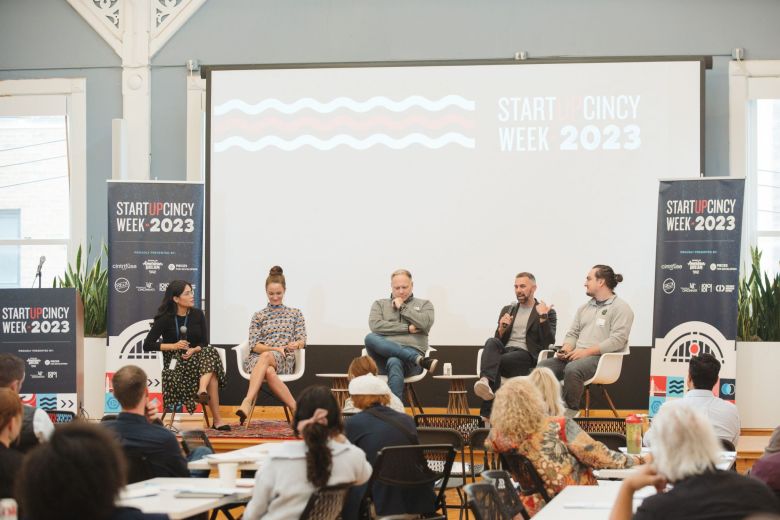
Metzner had been an adjunct professor at the University of Cincinnati. This led to his partnership with Blue North in Startup University held at SparkHaus. The program lasted 10 weeks and was open to students from any university in the region.
“We brought in different speakers each week, and a range of founders, investors, entrepreneurs, real estate, a little bit of a taste of everything to give students exposure to all parts of the venture journey. Students could join either at SparkHaus in person, or they could join remotely. The building is set up beautifully for both,” he said.
In addition to eGateway, Keyhorse, Commonwealth Seed and Fireroad, SparkHaus is also home to Kentucky Angel Collective, a new network of angel investors committed to supporting Kentucky entrepreneurs. Right across the street is Connetic Ventures, a founding sponsor of SparkHaus. Connetic offers its own artificial intelligence software named Wendal designed to remove bias in how startups are selected for funding.